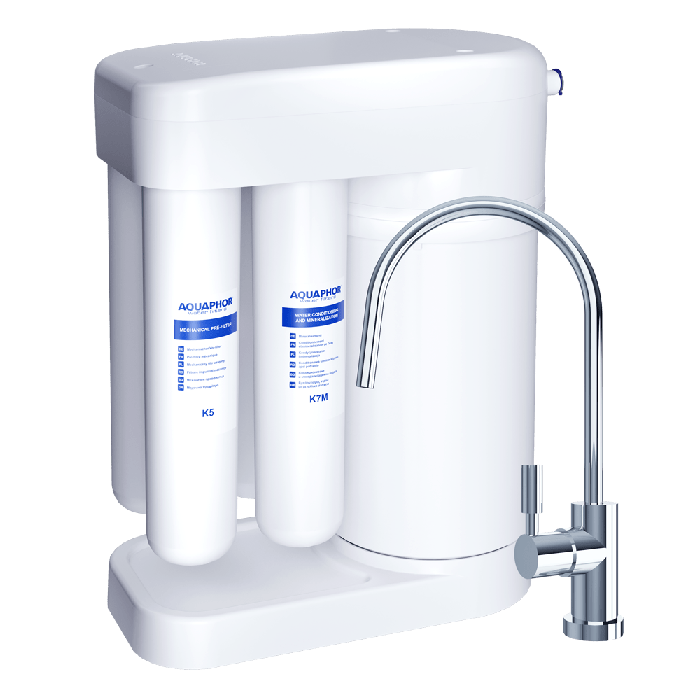
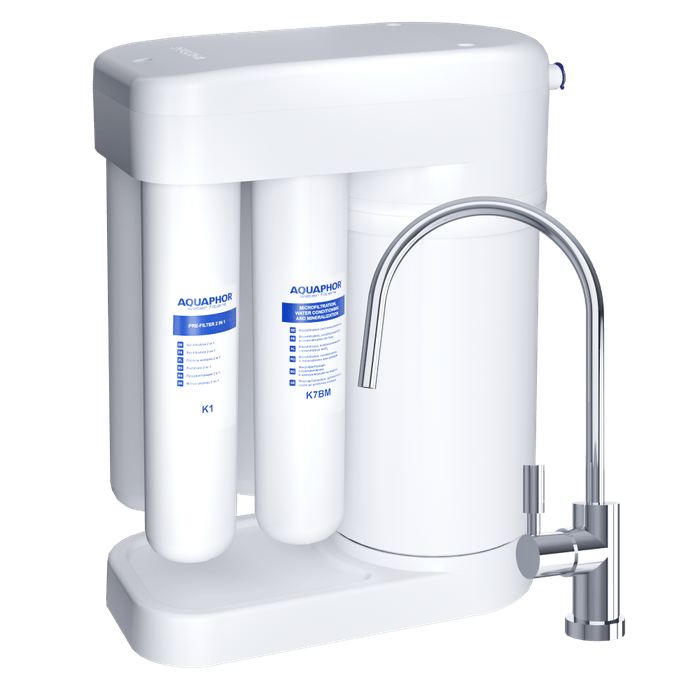
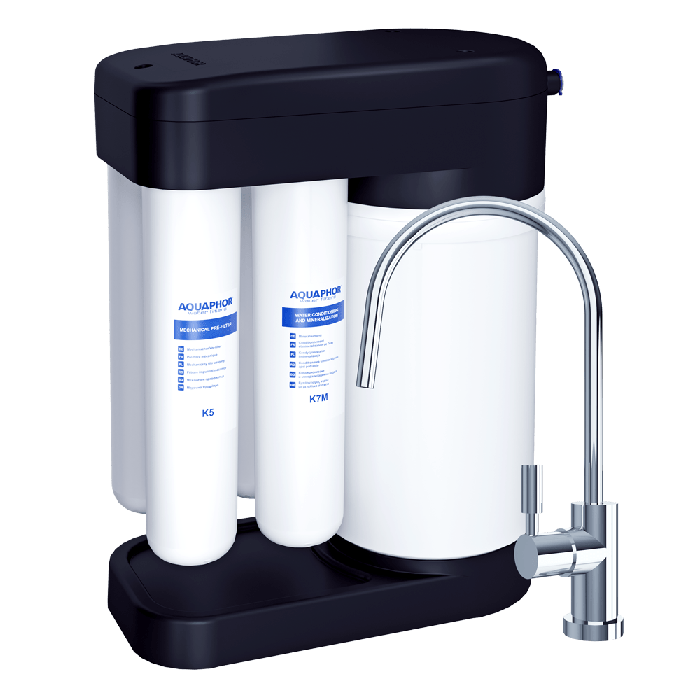
Reverse osmosis filters provide deep treatment of drinking water by reducing dissolved salts, hardness minerals and other contaminants. The system is installed beneath the kitchen sink, while treated water is supplied through a separate drinking water tap or a kitchen mixer with a dedicated filtered-water channel.
The AQUAPHOR range includes compact and conventional reverse osmosis systems, models with storage tanks, built-in pumps and mineralisation cartridges. The right system depends on the quality of the source water, water pressure, required flow rate and available installation space.
Water first passes through prefiltration cartridges. A mechanical filter traps sand, rust and other undissolved particles, while an activated carbon filter reduces chlorine and organic compounds. These initial filtration stages help protect the RO membrane from premature fouling.
The water is then forced under pressure through a semi-permeable membrane. Its nominal filtration size is approximately 0.0001 microns. The membrane allows primarily water molecules to pass while retaining most dissolved substances and other contaminants.
Treated water flows into a storage tank or directly to the drinking water tap, depending on the system design. Water containing the retained substances is discharged to the drain. At the final stage, the water may pass through a conditioning or mineralisation cartridge.
Reverse osmosis water purification helps reduce:
Actual filtration efficiency depends on the system model, source water composition, pressure, temperature and condition of the replacement cartridges.
Reverse osmosis filters are particularly suitable for very hard tap water. By reducing calcium and magnesium salts, the system helps prevent limescale from forming in kettles and other appliances. If the water comes from a well or another source of unknown quality, a water analysis is recommended before selecting a filtration system.
When choosing a system, consider:
A compact reverse osmosis system with an integrated tank may be suitable for a smaller kitchen. A conventional system with a separate storage tank requires more space but provides a reserve of clean water.
RO systems require stable water pressure. If the pressure in the water supply is below the level specified for the filter, choose a model with a built-in pump. The exact operating requirements should always be checked on the product page.
The flow rate indicates how much treated water the system can produce over a given period. It may be specified in litres per hour, litres per day or gallons per day. Actual output is affected by membrane type, water pressure, temperature and the level of total dissolved solids in the source water.
A storage tank keeps a supply of treated water ready for use and provides a steady flow from the tap. Its usable capacity may be lower than its total volume because part of the tank contains a pressurised air chamber.
Compact systems with an integrated tank require less space. High-flow reverse osmosis systems may also provide water without a large external tank. The most suitable design depends on water usage and the layout of the kitchen.
The RO membrane reduces both unwanted contaminants and naturally occurring dissolved minerals, including calcium and magnesium. A mineralisation cartridge is installed after the membrane to adjust the mineral content and taste of the treated water.
Mineralisation is not required for a reverse osmosis system to work. Choosing a filter with or without this additional stage depends on personal taste and the configuration of the particular model.
A reverse osmosis water filter connects to the cold-water supply and drain. Clean drinking water is delivered through a separate drinking water tap or a compatible kitchen mixer.
During installation, the drain connection must be fitted correctly, all connections checked for leaks and the filtration system flushed according to its instructions. Sufficient space should be left not only for the filter and storage tank but also for the tubing and future cartridge replacement.
Prefilters, the RO membrane and final conditioning cartridges can have different service lives. Replacement intervals depend on the system model, water quality and consumption. Compatible filters and membranes for reverse osmosis systems should be selected for the installed model.
The range includes compact and conventional AQUAPHOR reverse osmosis systems with different flow rates, storage tank capacities and configurations. Current prices, dimensions, water pressure requirements and other specifications are provided on each product page.
Choose a suitable system and order online with delivery throughout Latvia. Professional installation and maintenance can also be ordered for systems that require connection.
Reverse osmosis is a water purification process in which water is forced under pressure through a semi-permeable membrane. The membrane allows primarily water molecules to pass while retaining most dissolved salts and other contaminants.
The choice depends on water quality, water pressure, required output, the number of users and available installation space. A system with a pump may be required for low water pressure, while a compact model with an integrated tank may be more convenient for a smaller kitchen.
Yes. An RO membrane reduces calcium and magnesium salts that cause water hardness and limescale. The prefiltration cartridges must be replaced on time to protect the membrane and maintain the efficiency of the system.
Water treated by a correctly installed and regularly maintained system can be used for drinking and food preparation. If the source water comes from a well or another source of unknown quality, it should be analysed before selecting the system.
The membrane reduces most dissolved substances, including calcium and magnesium salts. If you prefer to adjust the mineral content and taste of the treated water, you can choose a system with a mineralisation cartridge.
No. A mineralisation cartridge is not required for the system to operate. It is used as a final treatment stage to adjust the mineral content and taste of RO water. Whether it is needed depends on personal preference.
No. Reverse osmosis and distillation are different water treatment processes. An RO membrane significantly reduces dissolved salts, but the final water composition depends on the system, source water and operating conditions.
The system requires connections to the water supply and drain, occupies space beneath the sink and needs regular cartridge and membrane replacement. During the filtration process, some water containing the retained contaminants is discharged as waste water.
The amount of water discharged to the drain depends on the system model, water pressure, temperature and membrane condition. There is no single treated-water-to-waste-water ratio for all RO systems, so this figure should be checked in the technical specifications of the selected filter.
Replacement intervals depend on the system model, source water quality and water usage. Prefiltration cartridges generally require replacement more frequently than the membrane. The exact maintenance schedule is provided in the instructions for the particular filter.
A TDS meter uses electrical conductivity to estimate the total dissolved solids in water. It can be used to compare water before and after the membrane, but it does not identify individual contaminants or confirm that the water is safe to drink.
An analysis is not always necessary for a standard municipal water supply. It is recommended when the water comes from a well or another private source, its composition is unknown, or it has an unusual colour, odour or sediment. The results can help determine the appropriate system and any required pretreatment.