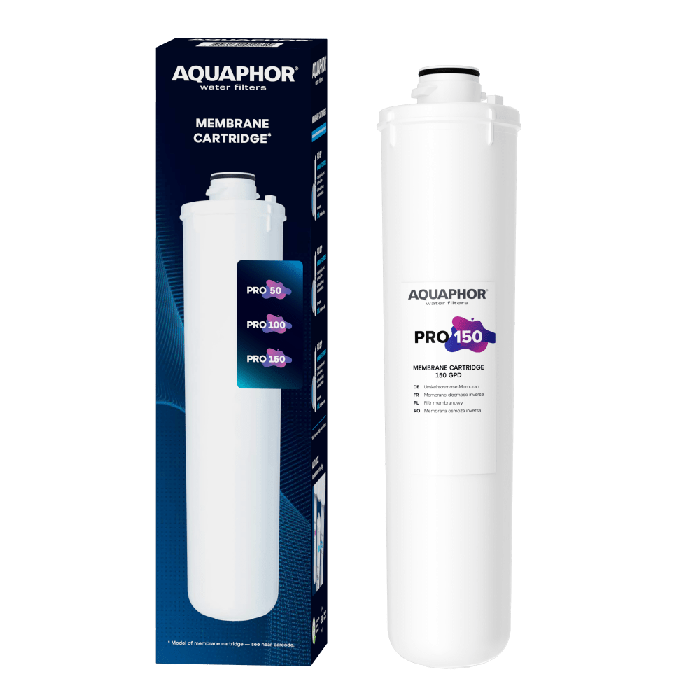
Reverse osmosis membranes

Filters
Close
Filter type
Model
First choose filter type
Found
by popularity
by popularity
RO-100S
RO-100S

Ultra-fine water purification and absolute water softening cartridge

• Purifies up to 375 liters of water per day
• Removes bacteria and viruses
• Reduces nitrites, nitrates, and antibiotic residues
• Completely removes hardness salts, preventing limescale formation
• Production capacity: 100 GPD (up to 15.6 L/h)

Compatible with: RO-70S EU, RO-102S, RO-102S EU, Dispenser RO PRO 100

52 €
RO-50S
RO-50S

High-performance purification and absolute water softening

• Purifies up to 190 liters of water per day
• Removes bacteria and viruses
• Removes heavy metals, nitrates and other impurities
• Completely softens water and prevents limescale formation
• Productivity: 50 GPD (7.8 L/h)

Compatible with: RO-70S, RO-101S, RO-101S EU

46 €
Pro 100
Pro 100

Deep Water Purification and Limescale Protection

• Purifies up to 380 liters of water per day
• Removes bacteria and viruses
• Removes nitrites, nitrates, and antibiotic residues
• Completely removes hardness salts, preventing limescale buildup
• Productivity: 100 GPD (15.8 L/h)

Compatible with: Osmo Pro 100, RO-202S Pro, Dispenser W3101-2F, Dispenser H2O-c

70 €
Pro 50
Pro 50

Deep Water Purification and Limescale Protection

• Purifies up to 190 liters of water per day
• Removes bacteria and viruses
• Removes nitrites, nitrates, and antibiotic residues
• Completely removes hardness salts, preventing limescale buildup
• Productivity: 50 GPD (7.9 L/h)

Compatible with: Osmo Pro 50

55 €
RO-50
RO-50

High-performance purification and absolute water softening

• Purifies up to 190 liters of water per day
• Removes bacteria and viruses
• Removes heavy metals, nitrates and other impurities
• Completely softens water and prevents limescale formation
• Productivity: 50 GPD (7.8 L/h)

Compatible with: RO-101

46 €
RO-100
RO-100

Ultra-fine water purification and absolute water softening cartridge

• Purifies up to 375 liters of water per day
• Removes bacteria and viruses
• Reduces nitrites, nitrates, and antibiotic residues
• Completely removes hardness salts, preventing limescale formation
• Production capacity: 100 GPD (up to 15.6 L/h)

Compatible with: RO-102

52 €
RO-150S
RO-150S

Deep Water Purification and Limescale Protection

• Purifies up to 568 liters of water per day
• Removes bacteria and viruses
• Removes nitrites, nitrates, and antibiotic residues
• Completely removes hardness salts, preventing limescale buildup
• Productivity: 150 GPD (23.7 L/h)

Compatible with: RO-206S - HoReCa

70 €
Pro 150
Pro 150

Deep Water Purification and Limescale Protection

• Purifies up to 570 liters of water per day
• Removes bacteria and viruses
• Removes nitrites, nitrates, and antibiotic residues
• Completely removes hardness salts, preventing limescale buildup
• Productivity: 150 GPD (23.7 L/h)

Compatible with: RO-206S PRO - HoReCa

75 €
Show more 2

Reverse osmosis membranes are the main purification elements in RO systems. They help reduce dissolved solids, hardness salts, heavy metals and other contaminants in drinking water. A reverse osmosis membrane also forms a physical barrier that bacteria and viruses do not normally pass through.

When choosing a replacement membrane, consider more than its GPD rating. The membrane must be compatible with the specific reverse osmosis system. RO membranes with the same rated output may differ in their design, connections and intended application.

How Reverse Osmosis Membranes Work


Before reaching the membrane, feed water passes through pre-treatment cartridges. Sediment filters capture sand, rust and other undissolved particles. Activated carbon reduces chlorine and organic compounds that could damage the membrane surface or shorten its service life.

The pre-treated water is then forced through a semi-permeable membrane. Its nominal filtration rating is approximately 0.0001 microns. Water molecules pass through the membrane, while most dissolved salts and other contaminants remain in the concentrate stream.

The RO process produces two water streams:

  • purified permeate water is sent to a storage tank or directly to the drinking water tap;
  • concentrate water containing a higher level of rejected substances is discharged to the drain.

By reducing hardness minerals and dissolved salts, reverse osmosis technology also helps prevent limescale in kettles, coffee machines and other household appliances.

How to Choose a Reverse Osmosis Membrane: 50, 100 or 150 GPD


GPD means gallons per day. It indicates how much purified water a membrane can produce under the specified operating conditions.

Membrane output Nominal purified water production AQUAPHOR membranes
50 GPD up to 190 litres per day RO-50, RO-50S, Pro 50
100 GPD up to 375-380 litres per day RO-100, RO-100S, Pro 100
150 GPD up to 568 litres per day RO-150S

A higher GPD rating does not necessarily mean better filtration. It primarily indicates how much clean water the membrane can produce within a given period.

When selecting a membrane, consider:

  • the exact reverse osmosis system model;
  • membrane compatibility;
  • the required amount of drinking water;
  • the available feed pressure;
  • whether the system has a booster pump;
  • feed water quality and temperature;
  • the dimensions and design of the membrane element;
  • compatibility with the system's flow restrictor.

A 100 GPD membrane should replace a 50 GPD membrane only when the RO system is designed for that output. Similar dimensions do not guarantee compatibility.

AQUAPHOR Membrane Compatibility


Membrane Output Compatible systems
RO-50 up to 190 l/day RO-101
RO-50S up to 190 l/day RO-70S, RO-101S, RO-101S EU
RO-100 up to 375 l/day RO-102
RO-100S up to 375 l/day RO-70S EU, RO-102S, RO-102S EU
Pro 50 up to 190 l/day Osmo Pro 50
Pro 100 up to 380 l/day Osmo Pro 100, RO-202S Pro
RO-150S up to 568 l/day RO-206S

Before purchasing, check the exact filter name on the system housing, in the user manual or in the purchase documents. The list of compatible systems should also be verified on the selected membrane's product page.

Water Pressure and Actual Membrane Output


The number of litres per day specified for a membrane is a nominal value. Actual RO membrane performance depends on:

  • feed pressure;
  • water temperature;
  • dissolved solids and salt concentration;
  • the condition of the pre-treatment cartridges;
  • membrane age;
  • overall system design and settings.

Reverse osmosis works by applying pressure greater than the natural osmotic pressure of the feed water. If the available pressure is too low, water flow through the membrane decreases and the storage tank takes longer to fill.

The required operating pressure should be checked in the instructions for the specific RO system. Some systems require a booster pump when the incoming water pressure is insufficient.

Reduced output does not always mean that the membrane has failed. Check the feed pressure, prefilters, connections and storage tank before replacing it.

Reverse Osmosis Membrane Service Life


There is no universal service life for all osmosis membranes. Replacement frequency depends on the membrane model, feed water quality, water consumption, operating pressure and timely prefilter replacement.

The following signs may indicate that membrane replacement is required:

  • a noticeable reduction in purified water production;
  • slow filling of the storage tank;
  • an increase in dissolved solids in the purified water;
  • the return of limescale;
  • a change in the taste of the water;
  • the end of the service period specified by the manufacturer.

RO membrane performance can be assessed with a TDS meter by comparing the feed water and permeate water readings. However, the result must be interpreted according to the source water and system specifications. A single TDS value is not a universal replacement threshold for every system.

How to Extend RO Membrane Life


The membrane must be protected from mechanical particles, chlorine and other substances that may damage its filtration layer. This is the purpose of the pre-treatment stages installed before the membrane.

To maintain reliable performance:

  • replace pre-treatment cartridges on time;
  • use the system only with cold tap water;
  • follow the operating pressure requirements;
  • do not allow an installed membrane to dry out;
  • flush the system after replacement according to the instructions;
  • do not use cleaning chemicals unless approved by the manufacturer;
  • check the system regularly for leaks.

Prefilters and reverse osmosis membranes usually have different replacement intervals and do not necessarily need to be changed at the same time.

Buy a Reverse Osmosis Membrane in Estonia


The range includes AQUAPHOR reverse osmosis membranes rated at 50, 100 and 150 GPD for compatible household systems. The current price, availability, output and list of suitable filters are provided on each product page.

If you need a complete filtration system rather than a replacement membrane, explore the range of AQUAPHOR reverse osmosis systems. Information about receiving your order is available in the payment and delivery section.

FAQ

A reverse osmosis membrane is a semi-permeable filtration element through which water is forced under pressure. It helps reduce dissolved salts, hardness minerals, heavy metals and other contaminants. The membrane also provides a physical barrier against bacteria and viruses.

First identify the exact model of the RO system. Then check membrane compatibility, GPD output, required feed pressure and the manufacturer's instructions. Do not choose a membrane by its dimensions or appearance alone.

The main difference is nominal output. A 50 GPD membrane can produce up to 190 litres of purified water per day, while a 100 GPD model can produce up to 375-380 litres. Actual output depends on water pressure, temperature and feed water quality.

Only if the reverse osmosis system is designed to work with the higher-output membrane. The membrane housing, flow restrictor and other components must also be compatible. An unsuitable membrane can affect the balance and efficiency of the entire system.

Membrane life depends on its model, source water quality, consumption and the condition of the prefilters. Follow the maintenance schedule for the specific system and monitor the actual quality and flow of the purified water.

Possible signs include reduced output, slow storage tank filling, higher TDS in the purified water, a change in taste or the return of limescale. Similar symptoms can also be caused by low pressure or clogged prefilters, so the whole system should be checked.

Yes. After installation, the membrane and system must be prepared and flushed according to the user manual. The first batches of purified water are normally discarded rather than used for drinking.

Household RO membrane modules are generally designed for replacement. Unapproved chemical cleaning can damage the membrane surface and affect the integrity of the system. Cleaning should be performed only when it is specifically permitted by the manufacturer.

Yes, if the system instructions allow it and you can safely shut off the water, release the pressure and install the replacement correctly. After replacement, flush the system and check all connections for leaks. Professional service is recommended if you do not have the necessary experience.

Yes. Insufficient pressure reduces the filtration rate and increases the time needed to fill the storage tank. The required operating pressure depends on the RO system and should be checked in the manufacturer's instructions.

AQUAPHOR uses cookies

Our websites require some cookies to function properly ("Strictly Necessary"). In addition, we use our own and third-party cookies and similar technologies to analyze site usage, improve and personalize the user experience, and for advertising. For more information, please review the "Customize cookies" link. By continuing you to receive all cookies on all AQUAPHOR websites.

Customize cookies

Reject optional cookies
Accept all cookies