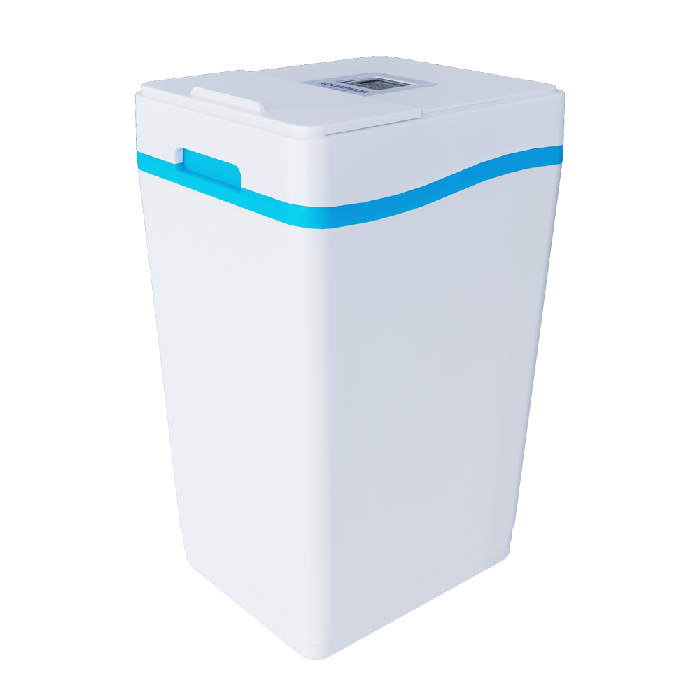
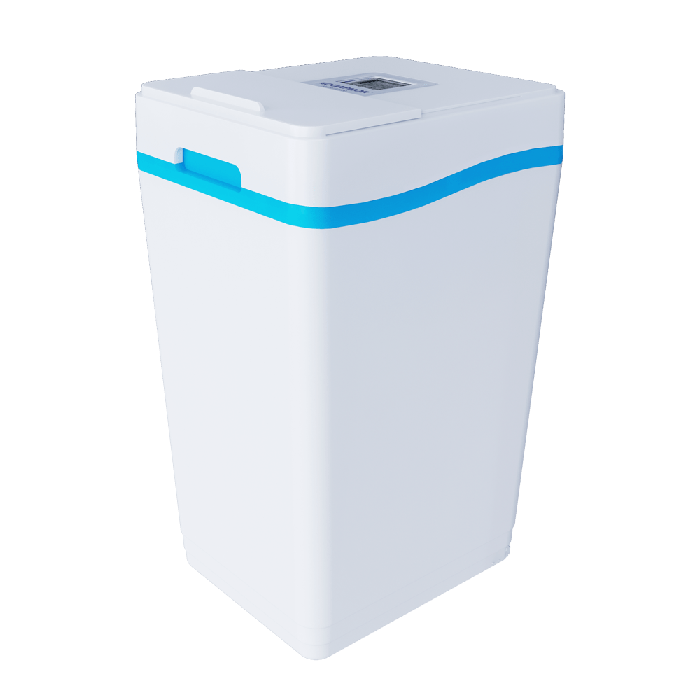
A water softener reduces hardness minerals and helps protect water heaters, washing machines, dishwashers, plumbing fixtures and pipes from scale buildup.
Hard water is primarily caused by dissolved calcium and magnesium compounds. When hard water is heated, it forms white residue and limescale deposits that reduce the efficiency of heating elements and may shorten the life of household appliances.
AQUAPHOR water softeners are designed to treat the water supply throughout the house. Depending on the model, they can also reduce dissolved iron, manganese, hydrogen sulphide or organic contaminants.
A water softener contains ion exchange resin. As water enters the system, the resin retains calcium and magnesium ions and replaces them with sodium ions. This process reduces water hardness and helps prevent limescale buildup.
Over time, the ion exchange resin reaches the end of its working capacity. The water softener system restores it through regeneration with a salt solution. During this process, the accumulated calcium and magnesium are removed from the resin and discharged to the drain with the rinse water.
After regeneration, the softener is ready to work again. The user needs to monitor the salt level and add salt to the brine tank when required.
Softened water helps:
A water softener is not a universal filter for every contaminant. Additional water treatment stages may be required to remove sand, rust, chlorine, organic compounds or microorganisms.
A water analysis is recommended before purchasing a system. It identifies the water hardness and other parameters that affect equipment selection.
Important parameters include:
Without an analysis, you may choose a system with insufficient capacity or treatment functions that do not match the actual water quality.
If the water comes from a private well, hardness alone is usually not enough to select the correct solution. Elevated iron, manganese or hydrogen sulphide requires a water softener with suitable filter media.
Consider the following factors:
The flow rate shows how much water the system can process per hour without a noticeable reduction in effectiveness or pressure. The appropriate size should be based not only on average consumption but also on simultaneous use of showers, washing machines, kitchen taps and other outlets.
An undersized softener may restrict water flow and regenerate too frequently. An unnecessarily large system takes up more space and can increase the purchase cost without providing a practical benefit.
| Model | Flow rate | Water used for regeneration | Salt used for regeneration | Main treatment tasks |
|---|---|---|---|---|
| WaterBoss 700 | operating 1.5 m³/h, maximum 2.3 m³/h | 61-95 l | 1.14-2.95 kg | hardness, mechanical particles and dissolved iron |
| S550 | 1.5 m³/h | from 50 l | from 0.8 kg | hardness, iron and manganese |
| S550 P1 | 1.5 m³/h | from 50 l | from 0.8 kg | hardness, iron, manganese and hydrogen sulphide |
| S800 | 1.6 m³/h | 66-90 l | from 1 kg | hardness, iron and manganese |
| S800 P1 | 1.6 m³/h | 66-90 l | from 1 kg | hardness, iron, manganese and hydrogen sulphide |
| S1000 | 1.8 m³/h | 67-97.3 l | from 1.1 kg | hardness, iron and manganese |
| S1000 P1 | 1.8 m³/h | 67-97.3 l | from 1.1 kg | hardness, iron, manganese and hydrogen sulphide |
| S1000 A | 1.8 m³/h | 67-97.3 l | from 1.1 kg | hardness, iron, manganese and organic contaminants |
The S550 is the most compact model in the range and is suitable for lower water consumption. The S800 provides a higher flow rate, while the S1000 is designed for greater demand and more intensive use.
P1 models are intended for water containing hydrogen sulphide in addition to hardness minerals, iron and manganese. The S1000 A also helps reduce organic contaminants. A specialised model should be selected according to the water analysis results.
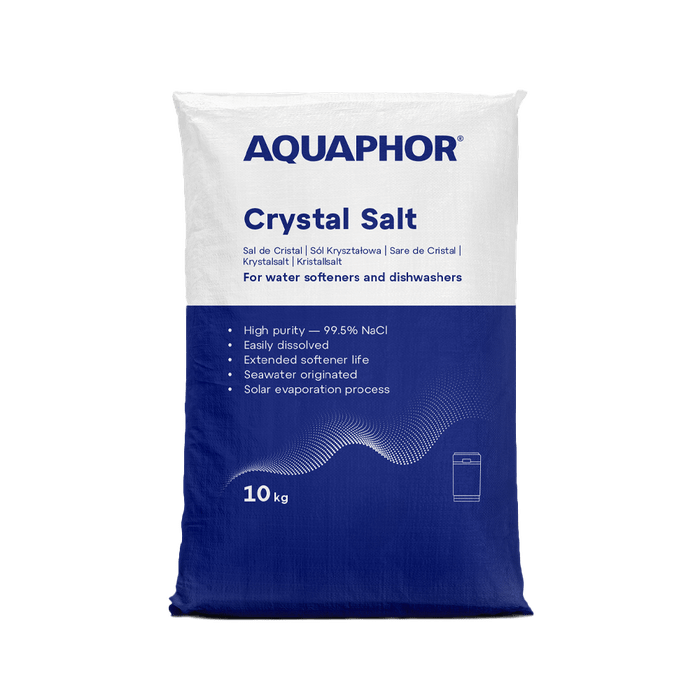
Regeneration restores the ability of the resin beads to reduce water hardness. A special water softener salt containing sodium chloride is used for this process.
The frequency of regeneration depends on:
During regeneration, the softener uses water for rinsing and discharges it to the drain. Depending on the model, the process usually takes between 18 and 40 minutes.
Ordinary table salt is not intended for continuous use in an automatic softener. Use salt that meets the equipment manufacturer's requirements. Potassium chloride may be used by some traditional water softeners, but only when expressly permitted by the manufacturer.
The AQUAPHOR range includes compact water softening systems for houses and other properties. Models differ in flow rate, dimensions, regeneration water and salt consumption, and their ability to reduce additional contaminants.
The current price, technical specifications, package contents and source water requirements are provided on each product page. Choose a suitable water softener and order online. Information about receiving your order is available in the payment and delivery section.
A water softener is a water treatment system that uses ion exchange resin to reduce calcium and magnesium ions. These dissolved minerals are the main causes of hard water and limescale.
It helps protect pipes, plumbing fixtures, water heaters and household appliances from scale buildup. Soft water also reduces white residue and allows soap and detergent to lather more easily.
Signs of hard water include white residue on fixtures, scale in a kettle, spots on glassware and reduced soap lather. The exact hardness level can be determined through a water analysis and may be expressed in mg/l or other local units.
The correct system depends on the water analysis, consumption, number of users, required flow rate and available installation space. If the water contains iron, manganese, hydrogen sulphide or organic contaminants, choose a model designed to reduce them.
Automatic salt-based ion exchange systems are commonly used to treat the entire household water supply. Softening filter cartridges can be used for local treatment, while reverse osmosis is suitable for deeper treatment of drinking water.
Salt-free systems generally condition minerals to reduce scale formation rather than removing calcium and magnesium from the water.
Yes, but the water softener must be sized according to the actual hardness, consumption and other water quality parameters. Very hard water may require more frequent regeneration or a larger volume of ion exchange resin.
A water softening system is primarily designed to prevent new scale buildup. It does not replace mechanical or chemical cleaning of equipment that already contains a thick layer of limescale.
Existing deposits may gradually loosen after softened water is introduced. However, water heaters, kettles, coffee machines and other appliances should still be descaled separately when necessary and according to the manufacturer's instructions.
Some models reduce dissolved iron while also softening the water. The permitted iron concentration depends on the specific system. Water with a more complex composition may require an additional filter.
Use salt specifically intended for water softening systems. It dissolves consistently and contains fewer impurities that could accumulate in the brine tank or interfere with system operation.
The refill interval depends on water hardness, household consumption, system settings and brine tank capacity. Check the salt level regularly and refill it according to the instructions rather than following a fixed schedule.
If the water contains sand, rust or other mechanical particles, a prefilter is recommended. It helps protect the control valve and filter media from contamination.
No. A shower filter treats water only at one outlet and usually does not remove the calcium and magnesium responsible for water hardness. A whole-house water softener treats the main water supply before it reaches showers, kitchen taps and appliances.
Installation requires connections to the water supply, drain and usually the electrical system. Professional installation is recommended to ensure correct regeneration settings, suitable flow and protection against leakage.
This depends on the source water, degree of softening and system requirements. Ion exchange increases the sodium concentration, so an unsoftened water supply or additional filter may be used for the kitchen tap, especially where a low-sodium diet is required. The decision should be based on a water analysis and the manufacturer's recommendations.