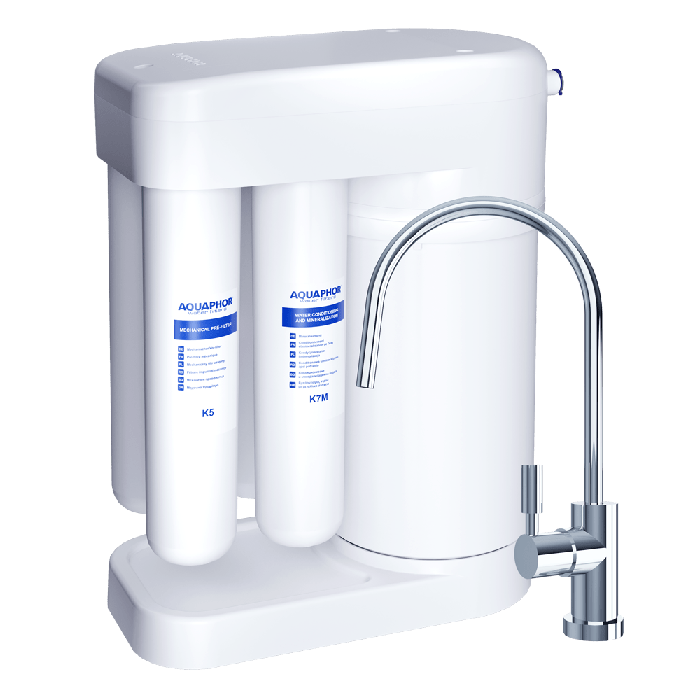
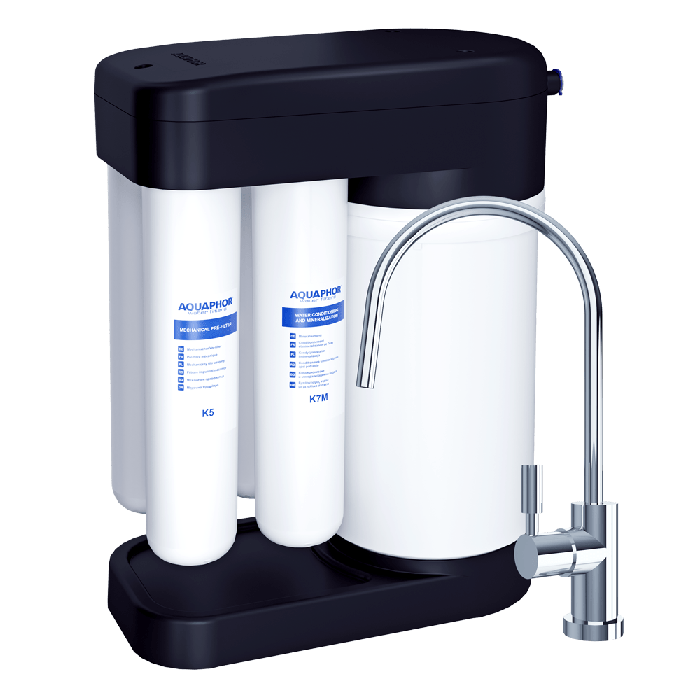
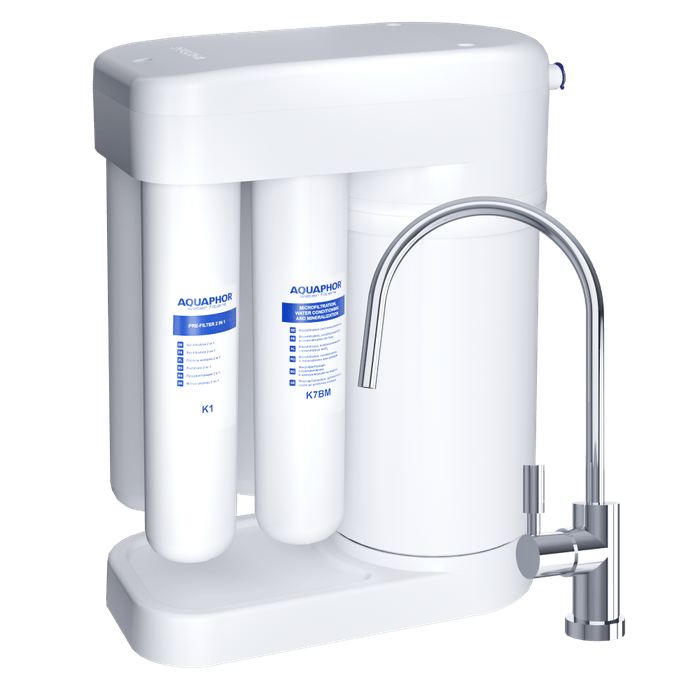
A water RO system provides deep purification of drinking water by reducing dissolved substances, hardness salts and other contaminants. The system is installed under the kitchen sink and supplies purified water through a dedicated faucet or a compatible kitchen mixer with a separate channel.
The AQUAPHOR range includes compact and traditional reverse osmosis systems with storage tanks, remineralization, built-in pumps and electronic controls. The right model depends on source water quality, water pressure, required flow rate and the available space under the sink.
Water purification takes place in several stages. Tap water first passes through replacement filters that trap sediment, sand and rust. An activated carbon or carbon block cartridge reduces chlorine, volatile organic compounds and other substances that could affect the RO membrane.
The pretreated water is then forced through a semi-permeable membrane under pressure. The reverse osmosis membrane allows water molecules to pass while retaining a large proportion of dissolved salts and other contaminants. Filtered water flows to a storage tank or directly to the drinking water faucet, while concentrate containing the retained substances is sent to the drain.
During the final stage, purified water may pass through a conditioning or remineralization cartridge. This stage can adjust the taste and mineral composition of RO water. The number of filter cartridges and their functions depend on the selected system.
Depending on the model and operating conditions, reverse osmosis filters can reduce:
Actual contaminant reduction depends on the membrane, source water quality, pressure, temperature and the condition of the filters. Water quality should not be assessed by taste or appearance alone.
Reverse osmosis is particularly suitable for hard water. Unlike a conventional softening cartridge, an osmosis membrane separates dissolved calcium and magnesium compounds and helps reduce limescale in kettles, coffee machines and other household appliances.
If the water supply comes from a private well or another source with an unknown composition, water testing is recommended before selecting a system. The results can show whether additional pretreatment is required.
Consider the following factors:
The stated flow rate indicates how much purified water the system can produce within a given period. Actual performance varies with water pressure, temperature and the concentration of dissolved substances.
A filtration rate of approximately 7.5-7.8 litres per hour may be sufficient for a small household. For higher water usage, a system producing around 15 litres per hour may be more convenient. Check the specifications of the individual model before purchasing.
A storage tank keeps purified water ready for use and supplies it as soon as the faucet is opened. This is useful because water passes through the RO membrane more slowly than through a conventional flow-through filter.
The usable tank capacity may be lower than its total volume because an air chamber occupies part of the internal space. The product range includes compact reverse osmosis systems with an integrated tank and traditional systems with a separate storage tank
A compact reverse osmosis system takes up less space and can be easier to fit under the sink. A traditional design with a separate tank requires more room but also maintains a reserve of filtered water. Measure the cabinet before buying and leave enough space for tubing, connections and future filter replacement.
Adequate water pressure is required to force water through the membrane. If the pressure is below the minimum specified for the model, filtration speed may fall, the tank may fill more slowly and more water may be discharged to the drain.
For a low-pressure water supply, choose an RO system with a built-in pump. The pump maintains the pressure required for stable membrane performance and efficient tank filling.
A pump requires electricity and may produce some operating noise. Check the power, pressure and noise requirements of the selected model and make sure that a suitable electrical outlet is available near the installation point.
The RO membrane reduces both unwanted contaminants and dissolved mineral salts. A remineralization cartridge is fitted after the membrane to adjust the mineral composition and taste of the treated water.
Remineralization is not required for the filtration process itself. Whether to choose this option depends on the system configuration and personal taste preferences.
In some AQUAPHOR systems, mineral adjustment is integrated into the storage tank or final treatment stage. Check the product page to see which filters are included.
Under-sink RO systems connect to the cold-water supply. They also require a drain connection for concentrate produced during the continuous filtration process.
Purified water is supplied through a dedicated drinking water faucet or a compatible kitchen mixer. Before purchasing, check whether the faucet is included and whether installation requires an additional hole in the sink or countertop.
Installation normally involves:
Some products in the Estonian range can be purchased with installation included. If you do not have plumbing experience or the sink must be drilled, professional installation is recommended.
An RO system uses prefilters, a reverse osmosis membrane and final treatment cartridges. These components perform different functions and do not necessarily have the same service life.
Replacement frequency depends on the system, water quality, pressure and usage. Prefilters generally require more frequent replacement because they protect the membrane from sediment and chlorine.
The following signs may indicate that maintenance is required:
Do not select a membrane or cartridge by appearance alone. All replacement filters must be compatible with the installed model. Suitable elements can be found in the reverse osmosis membranes and replacement filters for under-sink systems sections.
The range includes compact and traditional AQUAPHOR reverse osmosis systems with different flow rates, tank sizes and package contents. Available products include models with built-in pumps, remineralization, electronic controls, TDS monitoring and filter replacement indicators.
Current price, dimensions, filtration performance, pressure requirements and package contents are listed on each product page. Choose a suitable system and order online. Information about receiving your order is available on the payment and delivery page.
Reverse osmosis is a water purification process in which pressure forces water through a semi-permeable membrane. The membrane allows water molecules to pass while retaining a large proportion of dissolved salts and other contaminants.
A conventional flow-through filter generally uses mechanical, activated carbon and ion exchange materials. It improves taste and reduces chlorine and various other contaminants. A reverse osmosis system adds a membrane for deeper treatment of dissolved substances and hardness salts.
If the source water does not contain a high concentration of dissolved salts and limescale is not a concern, a conventional under-sink water filter may be sufficient.
Yes. An RO membrane reduces dissolved calcium and magnesium compounds that cause hardness and limescale. Prefilters must be replaced on time and pressure requirements followed to maintain reliable performance.
RO filtered water can be used daily for drinking and cooking when the system is correctly installed and properly maintained. If the source water has an unknown composition, it should be tested so that suitable pretreatment can be selected.
A remineralization cartridge is not necessary for the reverse osmosis process. It is used after the membrane to adjust the mineral composition and taste of purified water. Whether it is needed depends on personal preference and the configuration of the system.
No. Reverse osmosis and distillation are different water purification methods. An RO membrane significantly reduces total dissolved solids, but the final water quality depends on the system, source water and operating conditions.
An under-sink system occupies cabinet space, requires connections to the cold-water supply and drain, and needs regular filter replacement. Some water containing the retained contaminants is discharged to the drain. Models with a built-in pump also require electricity.
Water waste depends on system design, feed water pressure, temperature, membrane condition and source water quality. There is no single ratio that applies to all RO systems, so the relevant specification should be checked for the selected model.
A pump is required when water pressure is below the minimum specified for the system. It helps maintain membrane performance, flow rate and normal filling of the storage tank.
There is no universal replacement interval. Prefilters, the RO membrane and final cartridges have different capacities. The maintenance schedule depends on the model, water quality and consumption and is provided in the product instructions.
A TDS meter estimates the total dissolved solids in water through electrical conductivity. It can be used to compare readings before and after the membrane and detect changes in membrane performance. It does not identify individual contaminants or confirm that water is safe to drink.
Testing is not always necessary for a regulated municipal water supply. It is particularly useful when the water comes from a private well, has an unknown composition or shows unusual color, odor or sediment. Test results help determine the appropriate system and any additional pretreatment requirements.